One-time purchase. Lifetime access. No subscription.

ADHD and Inconsistent Business Income: The hidden Executive Function Problem
2/8/20264 min read
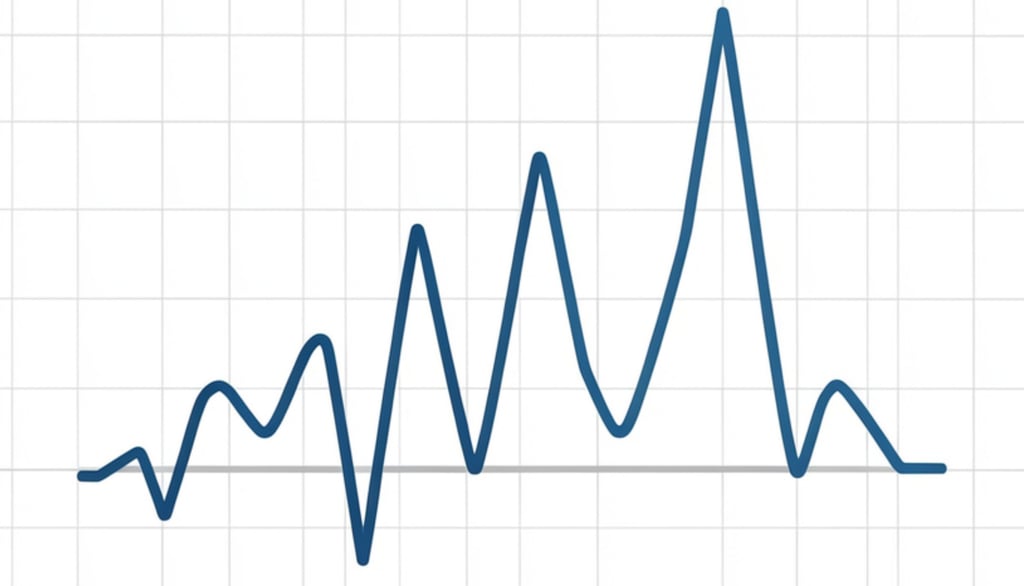
For the entrepreneur with ADHD, the financial graph often resembles a cardiac arrest: sharp vertical spikes of high revenue followed by long, flatline troughs of near-zero income. This phenomenon, commonly referred to as "ADHD inconsistent income," is rarely a result of poor market fit, lack of industry knowledge, or a low-quality product.
Instead, the instability is a direct output of executive dysfunction. In the context of business operations, executive functions - the cognitive processes that allow us to plan, focus, and execute - act as the "operating system" for revenue generation. When the operating system is prone to glitches, the output is inevitably volatile.
The Knowledge-Execution Gap
The most frustrating aspect of ADHD self-employment is the "Knowledge-Execution Gap." Most ADHD founders are high-information hunters. They understand marketing funnels, they know their sales scripts, and they have mastered their craft. However, the brain’s executive suite struggles to translate this knowledge into a consistent, linear sequence of actions.
In a neurotypical business model, revenue is the result of Boring, Repetitive Actions (BRAs). In a neurodivergent business model, the brain actively recoils from these actions. Because the ADHD brain is wired for novelty and urgency rather than importance and consistency, the very tasks that stabilize income - consistent outreach, follow-up, and administrative maintenance - are the first to be neglected.
The Mechanics of the Revenue Trough
To solve the problem of inconsistent income, we must first analyze the three specific executive function failures that drive the cycle:
1. The Cost of Momentum Loss (The Restart Tax)
Executive function deficits make "task switching" and "initiation" incredibly expensive in terms of cognitive energy. For an ADHD entrepreneur, stopping a marketing campaign because of a temporary loss of interest isn't just a pause; it is a total system shutdown.
When you stop an outreach sequence for two weeks, you don't just lose two weeks of data; you lose momentum. Re-starting that engine requires a massive burst of dopamine and activation energy that the founder may not have. This "Restart Tax" is the primary reason why ADHD business struggles persist. The business is constantly in a state of "starting over," never reaching the "compounding interest" phase of growth.
2. Impulsive Pivots and Unfinished Funnels
Hyperfocus is a double-edged sword. It allows a founder to build a 60% complete sales funnel in a single weekend. However, as the project nears the 80% mark - where the boring details like tracking pixels, email integrations, and proofreading reside - the executive system often flags.
Instead of finishing the last 20%, the ADHD brain seeks a "novelty hit" by pivoting to a new strategy, a new niche, or a new software stack. This results in a graveyard of unfinished assets. You have five half-built bridges that lead nowhere, rather than one completed bridge that carries traffic (and revenue).
3. The Procrastination-Urgency Cycle
Many ADHD entrepreneurs rely on "Adrenaline-Based Execution." They don't send invoices until the bank account is empty. They don't perform sales calls until a major client leaves. While urgency is a powerful activator, it is an unsustainable business strategy. It leads to "Heroic Efforts" followed by "Total Burnout." This creates a wave pattern: you work at 200% capacity to solve a crisis, then spend the next month in a state of cognitive exhaustion where no revenue-generating work happens.
The Fallacy of the "Next Big Strategy"
The standard industry response to inconsistent income is to buy a new course or hire a high-level strategist. For the ADHD entrepreneur, this is often a mistake. Adding more "information" to a system that cannot "execute" on existing information only increases cognitive load and guilt.
The problem is not a lack of strategy; it is a lack of infrastructure.
In engineering terms, if you have a high-performance engine (the ADHD brain) but a broken transmission (executive function), adding more fuel (new strategies) will not make the car move. You must fix the transmission. In business, that transmission is your Execution System.
Installing the Structural Solution
To stabilize ADHD inconsistent income, the founder must shift from "Owner-Operated Execution" to "System-Operated Execution." This involves three structural shifts:
Externalize the Executive Function
Since the internal ability to prioritize and follow through is unreliable, these functions must be externalized into a rigid system. This means using project management frameworks that do not rely on your "feeling" like doing the work. If the system says "Tuesday is Outreach Day," the decision is already made. You are not "deciding" to work; you are following an engineering schematic.
Standardize the "Boring" Baselines
Identify the absolute minimum viable actions (MVAs) required to keep revenue flowing. This might be five outbound emails or one social post. These must be decoupled from your mood. By standardizing these actions through checklists and automation, you ensure that even during "low-dopamine" weeks, the business does not hit zero.
Eliminate the Pivot Option
Constraint is the friend of the ADHD entrepreneur. By setting "Non-Negotiable Quarters," you prevent yourself from pivoting until a specific timeframe has passed. This forces the brain to solve problems within the current framework rather than seeking escape in a new one.
Conclusion: Volatility is a Choice
Inconsistent income is not an inherent trait of ADHD; it is a symptom of an unstructured execution environment. The "Hidden Executive Function Problem" is solvable through the application of rigorous systems that account for neurodivergent biology.
At The Function Lab, we believe that the goal of a business system isn't just to increase profit - it’s to reduce the cognitive tax of running the business. When you install a structured execution system, you stop relying on flashes of brilliance and start relying on the machine you’ve built. Stability is the result of engineering, not inspiration.
Support
Contact Us
hello@thefunctionlabco.com
The Function Lab | Entrepreneur OS™
© 2026 All Rights Reserved